Outrage Entrepreneurs
Monetizing the Dissolution of Civil Society

In a recent op-ed for Christianity Today, Russell Moore used the term “conflict entrepreneurs.” It’s brilliant, but it doesn’t go far enough. I prefer my derivative: Outrage Entrepreneurs. They’re not specific to any one American Tribe. They pepper the poles of our country’s political divide. About the only place you will not find them is in the reasonable center. They beckon from the margins, seeking to empty that middle.
That’s the way you start a war.
You first have to demonize the opposition. Renee Good isn’t simply a citizen exercising her right to protest. She’s a “domestic terrorist.” Alex Pretti now enjoys a similar status among the Outrage Entrepreneurs on the far right, though they struggle to make that case amid ubiquitous and damning video. For a reasoned assessment of enforcement action, check out this article, where the author draws a distinction between anti-law-enforcement and pro-professionalism.
What gets lost in all of this is the generally kind and decent American people, who know they are delightfully mixed mutts. The storied illustrator and portraitist of America’s 20th-century self, Norman Rockwell, showed us what that looks like, with tongue firmly in cheek.
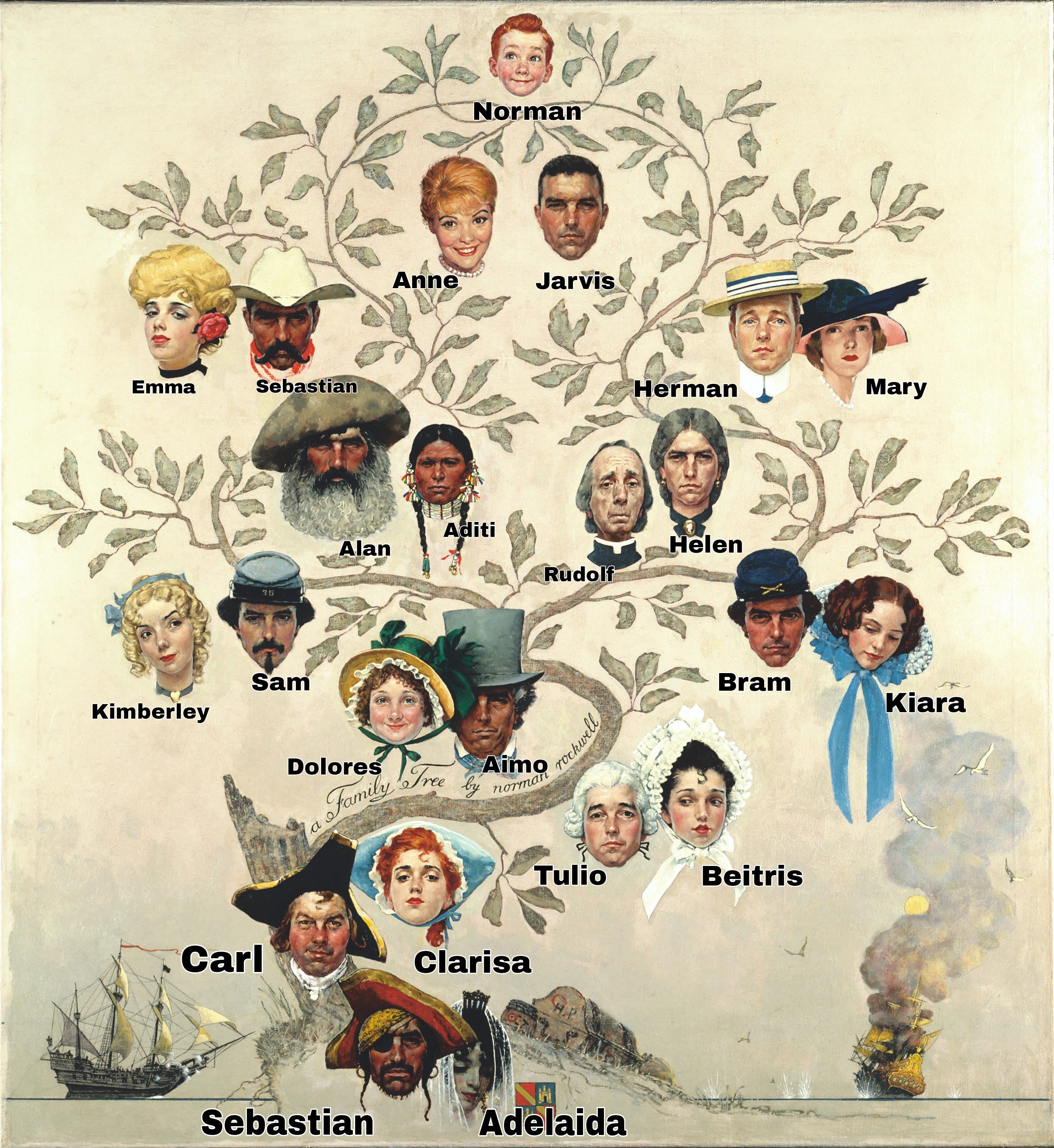
The cute, freshly freckle-faced lad is an idealized symbol for a country comprised of everyone from everywhere. That makes sense because the vast majority of human history is tribal. It is defined by borders, language, and culture. “Us” versus “them.” Human society still carries these distinctions throughout most of the world. And despite its recent problems, the U.S. has historically been more welcoming to foreign-born people than most developed nations. In general, liberal democracies modeled on the American experiment have sought something better than high walls and deep moats.
E Pluribus Unum, “out of many, one,” is not simply something printed on U.S. currency. It’s an ideal. It calls us to be a people not bound together strictly by borders and culture, but by an idea: one can live harmoniously, sharing an uncommon vision for the common good, and do so within a unity of diverse people. There is more than enough opportunity for everyone. I still believe in that ideal.
This idea finds its substance beyond the Declaration of Independence and the U.S. Constitution. It’s biblical. God’s story might have begun with one man, Abraham, and a culturally distinct people, the Israelites, but that was a means to an end:
“It is too small a thing for you to be my servant to restore the tribes of Jacob and bring back those of Israel I have kept. I will also make you a light for the Gentiles, that my salvation may reach to the ends of the earth.” —Isaiah 49:6
Fellow Christian, do you hear God’s voice here? Do you catch the vision? God’s ambition is to create a human family from “from every nation, tribe, people and language.” (Revelation 7:9) John’s Revelation continues:
The Spirit and the bride say, “Come!” And let the one who hears say, “Come!” Let the one who is thirsty come; and let the one who wishes take the free gift of the water of life.
—Revelation 22:17
This is even more radical. The qualification to be part of this family is thirst, not pedigree, productivity, global-positioning, or racial “purity.” This vision underscores God’s commands to Israel regarding foreigners. Citing the history of His people’s captivity in Egypt, God mandates that immigrants, strangers, and sojourners be treated with love, justice, and hospitality. He goes even further and commands Israel to treat them as native-born, providing for their needs, and avoiding oppression, since they are under God’s protection.
God continually calls His people to a costly, cruciform life (Matthew 10:37-39). And if you’re looking for more Bible regarding those who can claim His protection, it’s not hard to find.
“The foreigner residing among you must be treated as your native-born. Love them as yourself, for you were foreigners in Egypt. I am the Lord your God.” —Leviticus 19:34
It seems obvious that Christians are to advocate for the foreigners among us as those who are entitled to the same human rights as native-born people. That does not mean foreigners can reside in this country and dangerously flaunt its laws. But it also means that they deserve the same consideration and protections afforded to citizens throughout the legal process, including encounters with law enforcement.
“Do not mistreat or oppress a foreigner, for you were foreigners in Egypt.” —Exodus 22:21
“Cursed is anyone who withholds justice from the foreigner, the fatherless or the widow.”
—Deuteronomy 27:19
God is concerned with protecting the most vulnerable. He strictly forbids mistreating foreigners and warns against corrupting justice through an abuse of power. He does so during the Exodus, the definitive era of nationalization in Israel’s history. It’s almost as if God anticipates the eroding effects of a toxic nationalism on His vision of a just and humane society.
But what about the economic impact of this largess for foreigners?
‘When you reap the harvest of your land, do not reap to the very edges of your field or gather the gleanings of your harvest. Do not go over your vineyard a second time or pick up the grapes that have fallen. Leave them for the poor and the foreigner. I am the Lord your God.” —Leviticus 19:9-10
God’s provision for the marginalized, including the foreigner, is a voluntary distribution from the wealthy. A wholesale embrace of this value in our modern society is complicated. Taxes are compulsory, and governments waste money, but don’t retreat into the comfort of that critique and miss the bigger picture. The people, who we might be tempted to dismiss as a drain on national resources, enjoy God’s protection. He also expects us to participate in their provision at our expense.
The Lord watches over the foreigner and sustains the fatherless and the widow, but he frustrates the ways of the wicked. — Psalm 146:9
The psalmist seems clear. If we oppose God’s heart for these vulnerable people, explicitly including the “foreigner,” we can find ourselves on the opposite side of this issue from God. It’s perilous to do so as a people who are foolishly or selfishly in tune with an unholy spirit of the age.
In the Old Testament, these commands served as a counter-cultural mandate against mistreating outsiders. However, in the New Testament, this ethic is extended. Actually, it’s leveled up, requiring followers of Jesus to show compassion and hospitality to all as the living embodiment of Jesus’ Presence.
For I was hungry and you gave me something to eat, I was thirsty and you gave me something to drink, I was a stranger and you invited me in… —Matthew 25:35
Jesus is unequivocal here. Welcoming the “stranger” is equivalent to welcoming Him. Some might argue that this command is intended for small spaces such as homes and churches and doesn’t scale to nation-states. Respectfully, I think that analysis ignores the bulk of Scripture and the arc of God’s storied recreation of humanity, Heaven, and Earth. I believe that this intensely hospitable posture is the necessary medium through which the Gospel is conveyed.
The Gospel’s content is according to Romans 10:9-12 and 1 Corinthians 15:1-8. However, the medium — the means of transmission, if you will — is according to 2 Corinthians 5:11-21.
All this is from God, who reconciled us to himself through Christ and gave us the ministry of reconciliation: 19 that God was reconciling the world to himself in Christ, not counting people’s sins against them. And he has committed to us the message of reconciliation. 20 We are therefore Christ’s ambassadors, as though God were making his appeal through us. —2 Corinthians 5:18-20
The “through us” is crucial. Paul does not want to collapse the work of the Spirit into a merely human effort, but he clearly sees human interaction, human civil society, and the hospitable values of God’s Kingdom as a medium — the steaming platform of the Gospel. He sees the life-on-life interaction with those who are “other” as the means God uses to scour out the idolatry of competing “gods” among strangers and foreigners, like a hard east wind sweeping cleanly through the Columbia Gorge.
That’s a breathtaking vision. And it’s being sullied in our country by purposeful white-hot political polarization and the degradation of civil discourse.
So, how do we respond to the Outrage Entrepreneurs on both sides of the political spectrum? We step on their oxygen hose. We stop watching. We stop listening. We go back to church. We invite God’s Word and His Spirit to form us. We pray. We embrace the hard demands of the Gospel and the hard work of loving our neighbors. We ask God for the wisdom and power to do so. We give our allegiance first to Jesus, before country and flag. We Christians live as a consecrated people wherever God puts us. And with whomever He seats at our table. We love others as we love ourselves.
Cynics and the solely self-concerned may scoff at these simple steps. I can’t find it in myself to embrace that dismissal. I remain convinced that the Gospel is the power of God for salvation (Romans 1:16). It’s yours, mine, ours, and theirs. Whoever “they” are.
That must surely include the foreigner.
Addendum
John Piper is being excoriated for a tweet in which he quotes Leviticus 19, as I did above, in a way his critics see as woke. They respond that the foreign-born are to assimilate with the native population, keeping the Law as the Israelites were required to do.
Author Katy Faust, founder and president of the children’s rights nonprofit Them Before Us, echoed Hibbs by listing multiple references from the Torah that explain the foreigner and sojourner were “expected to respect and abide by the laws of Israel.”
No argument. But what Piper’s critics fail to mention is that these people immigrated while not observing the Law. They had no choice. It’s not like they could all enter Israel’s territory through a tidy system of comprehensive instruction in a synagogue, followed by circumcision. Most woudl be fleeing war or famine, not unlike our times. Scripture is unequivocal: they were to be embraced, cared for, and instructed from within, helping those who wished to be part of God’s people to do so. If Piper’s critics want to argue about the order of operations, fine. In addition to enforcement, advocate for a 10x increase in court capacity at the border and ESL programs with integrated civics instruction and job placement services in cities with ports of entry. That would drastically reduce the illegality of most immigrants.
We need a responsible dialogue about the generational failure of our nation’s immigration policy. Not a theocratic denouncement of Scripture’s imperatives. Maybe that’s all Piper was trying to say.
I agree. But you cannot forget that God did create his own people, and gave them their own culture, and defended it vigorously against those who would attempt to destroy it. Even in the Mosaic Law, he stressed that while foreigners are to be welcomed, they are to follow the law as if they were citizens of Israel. And even in the new Testament, Jesus was very clear: I am King, and you are with me or against me. This is the other side of the coin: welcome foreigners unreservedly, but they have a responsibility too, to not be deliberately disruptive to the culture they are joining, even if however briefly.